
Advocating Evidence-Based Learning
Empowered teachers.
Successful
students.
Proven results.
Technology doesn't replace great teachers — it makes them more effective. There’s a difference between screen time and learning time, and we must protect educators’ ability to use tools that reach every student and produce proven outcomes.

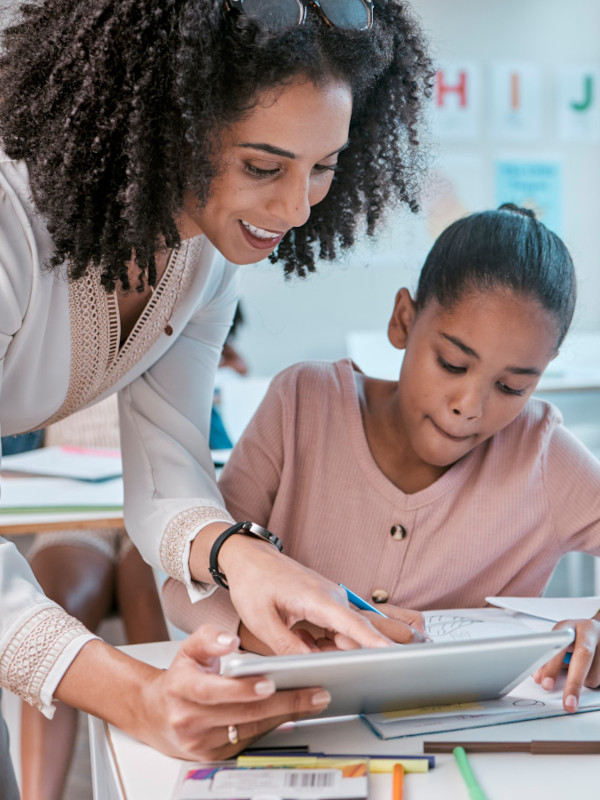
A teacher guides a student through a lesson — technology amplifies that human connection
Collaboration and curiosity — hallmarks of tech-enabled learning

Modern classrooms where every student can thrive
Technology is a tool in the hands of a great teacher — and great teachers deserve the best tools available.
About the Initiative
The human case for
digital learning
The best educational technology doesn't replace the teacher — it amplifies the teacher, freeing educators to do what matters most: connect with students, see where they struggle, and unlock their potential.
A coordinated movement is working to strip proven learning tools from America's classrooms — tools that help teachers support the struggling reader, the platform a student with a disability depends on – the tools that help students succeed.
The EdTech Works Initiative exists to defend them, and to help policymakers target the right technology instead of banning the tools that help students learn.


Insights
What we're working on

E-Rate Screen Time Policy: SIIA Comments to the FCC on E-Rate and Children’s Screen Use
SIIA’s comments on E-Rate screen time policy urge the FCC to preserve reliable broadband funding and leave instructional technology decisions with local educators. Filed in response to the Commission’s Notice of Proposed Rulemaking on children’s screen use, the...

New Parent Surveys Point to Purposeful Classroom Technology and Stronger Safeguards
Families support teacher-directed AI and clear protections, while favoring limits on early-grade screens and restrictions on student chatbot use. Parents’ views on classroom technology are more nuanced than a simple choice between unrestricted use and outright bans....

Stop Calling Everything on a Screen “Ed Tech”: The Case of Danny Go!
After watching the NTIA listening session on screentime Tuesday night,[1] I heard Danny Go! mentioned so often that you would have thought it was a common educational tool. In the likes of Ms. Rachel, it's a popular YouTube show capturing the attention of millions of...
Our Belief
Technology serves people.
People don't serve technology.

Empowering Educators
Education technology gives teachers deeper insight into each student's progress, so they can spend less time on rote tasks and more time on the human moments that change lives. The student and teacher remains at the center — always.

Unlocking the Potential of Every Student
The right learning technology meets students where they are — adapting to different learning styles, supporting students with disabilities, and ensuring no child is forgotten because of a one-size-fits-all approach.

Proven Outcomes
This isn't faith — it's evidence. Research confirms what great educators have always known: when technology supports the learning process, student outcomes improve.
What is Ed Tech?
Education technology helps teachers teach better and students learn more. It is purpose-built technology designed for classrooms, aligned to curriculum, and governed by schools—not consumer apps built for entertainment.
Education technology includes tools like adaptive reading and math programs, learning management systems, student information systems, and assessment platforms. These tools help teachers personalize instruction, track progress, and respond faster when students need support.
01
Built for learning
Education technology is designed for schools, and districts, with a specific instructional purpose and measurable learning goals.
02
Purposeful, Not Passive
Consumer apps, social media, and streaming platforms are made for passive use. Classroom education technology is educator-guided, structured, and tied to what students are learning.
03
Protected and accountable
School-based education technology operates under strong privacy rules, Federal laws and formal school oversight. It is governed by educators, not the open internet.
The right education technology gives teachers more time for direct instruction, provides immediate feedback, and helps students move forward at their own pace. It can also make learning more accessible for students with different needs, including those who rely on digital tools to fully participate in class.
That’s why the question is not whether a screen is involved. The real question is whether the technology is helping students learn, whether it is controlled by the school, and whether it has evidence to show it works.
When teachers are empowered,
Students are Unstoppable.
EdTech doesn't put a screen between a teacher and a student. It gives that teacher a superpower: the ability to know every student more deeply, move faster when a student is ready, and catch every child who starts to fall behind in a “walled garden” that protects student data, provides access, and blocks non-educational experiences.
Resources
Tools to advance the mission
01
Policy Makers
02
Media
03
Parents
04
Education Tech Companies
Contact
Join the initiative
or get in touch
Have a seat at the table
If your organization serves the educators and students who rely on digital learning tools, the question isn't whether screen-time legislation will affect you — it's when. Let's talk about your role in the initiative.